
The basis for a content strategy

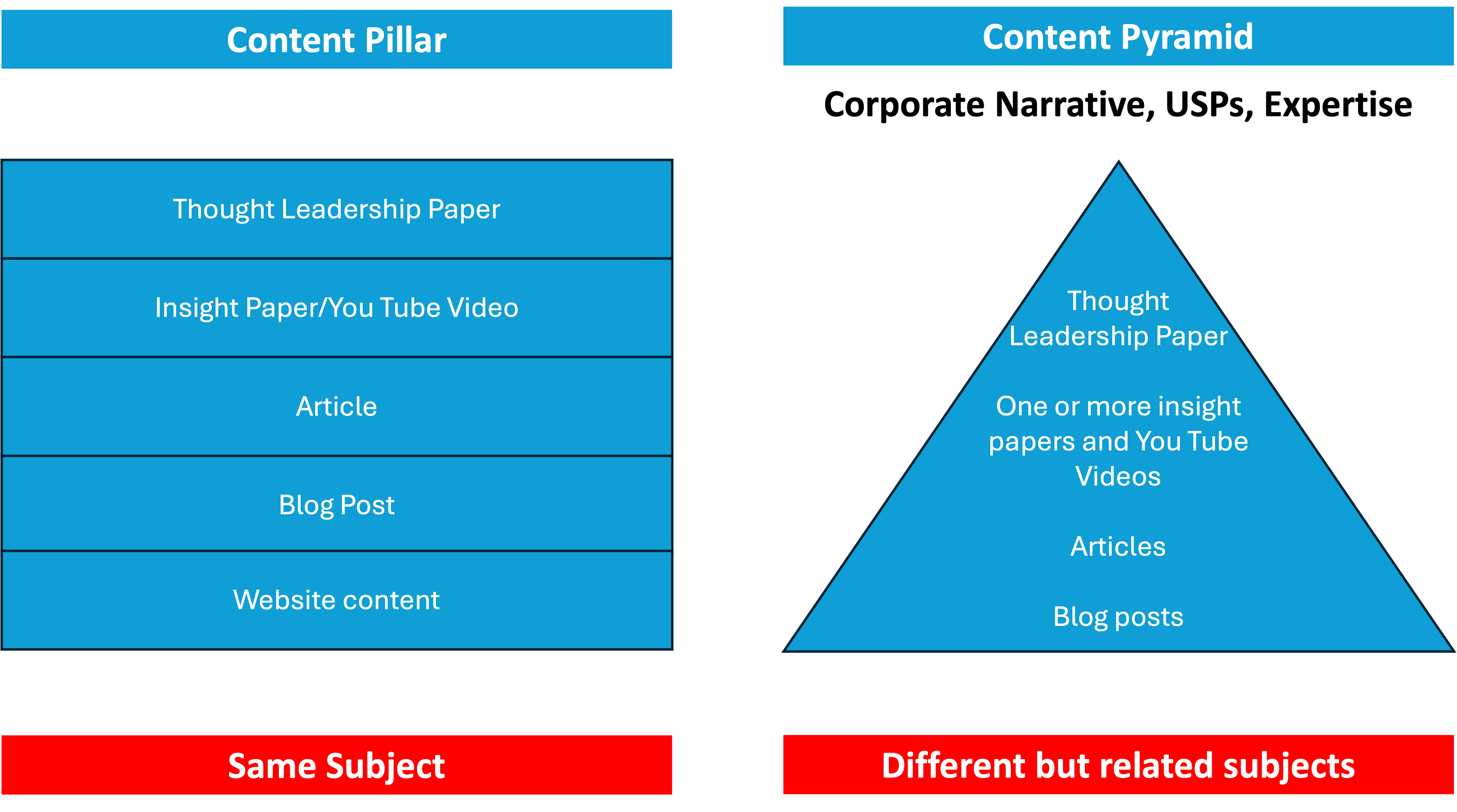
A content pyramid and one or more content pillars are the basis of your content strategy.
Let’s start from the beginning. What is the story of your company? What are the areas of expertise? What are its USPs? What is the problem you are going to solve?
Once you have an answer to those three questions, you can start building your content strategy.
1. Find your content pyramid(s). How can you show your expertise? A thought leadership paper does not discuss your product, it discusses the topic. At the end of the paper, you share your product’s features with the reader and show how it can solve that specific problem. The body of the paper discusses the problem, the trend, or whatever area of expertise you have decided to show the world. Shorter pieces of content do not need to talk about the same subject as the thought leadership paper, but they need to support the same corporate narrative. So, for instance, if you have software that takes care of regulatory reporting for one specific regulation. You can have a thought leadership paper about some interesting changes triggered by implementing that regulation, an insight paper on the data quality issues associated with the reporting, another one on the changes in the transaction workflow triggered by that report, and a blog post on how to sort out problems when something truncates the reporting process half-way.
2. Find your pillars. A content pillar is a topic you can use for a long white paper, shorter white papers, articles, blog posts, and web content. In its less creative format, they all talk about the same thing but for different audiences, in different media, etc. Or you can use them to assess a prospect’s interest in the topics. Website content is supposed to be read in less than five minutes. It may take 10 minutes for a blog post, half an hour for a short (insight) paper, and an hour for a thought leadership paper. You can figure out if a prospect is interested in knowing more if they climb through the layers of the pillars. By the time they reach the long white paper, they have shown enough interest for you to contact them if they haven’t contacted you already. A more creative approach would use the type of content in a lower layer to expand a different point raised in the layer above. The layers in a content pillar can give you an idea of a reader’s interest like the layer of the content pyramid.
Layers in both a pillar and a pyramid do not represent one piece of content. Following the same logic, you can have more than one content pillar. The important thing is to have a strategy that is coherent with your brand, your overall marketing strategy, and your plans.
I am a programme manager who turned into an expert in financial regulations. I worked all over the world, mostly in banking, and developed my storytelling skills, trying to find the story behind financial regulations. Now I tell stories about 1920s Venice, financial regulations, technology, and financial products, and help post-funding start-ups raise their profile.
Click the link below to organise a complimentary 30-minute Zoom meeting to discuss the stories behind your company and your products and how they can be turned into content.