
The difference between content marketing and advertising

Content reaches those that do not know you exist, and are looking for information about a topic or about a problem they need to solve rather than your product.
Advertising is telling the world that your product (or your company) exists and why they should buy it. It targets a specific subset of the population active in your business sectors.
Content gently nudges people towards your product and your company by discussing a topic of interest to the reader, or a problem the reader needs to solve. It flips the communication model 180 degrees. For instance, let us assume you want to promote an identity verification system.
Advertising:
Our AI-based system searches several government sanctions databases, and it allows you to verify whether a prospect is a Politically Exposed Person in real time during the onboarding process.
Content:
Politically Exposed Persons (PEPs) are individuals who have prominent public functions in their country or their organisation. They present a higher risk of potential involvement in bribery and corruption; therefore, they are considered more likely to save their cash outside the country.
[Discuss how regulators require identifying a PEP during the onboarding process and regularly verify the status of their clients as far as political exposure].
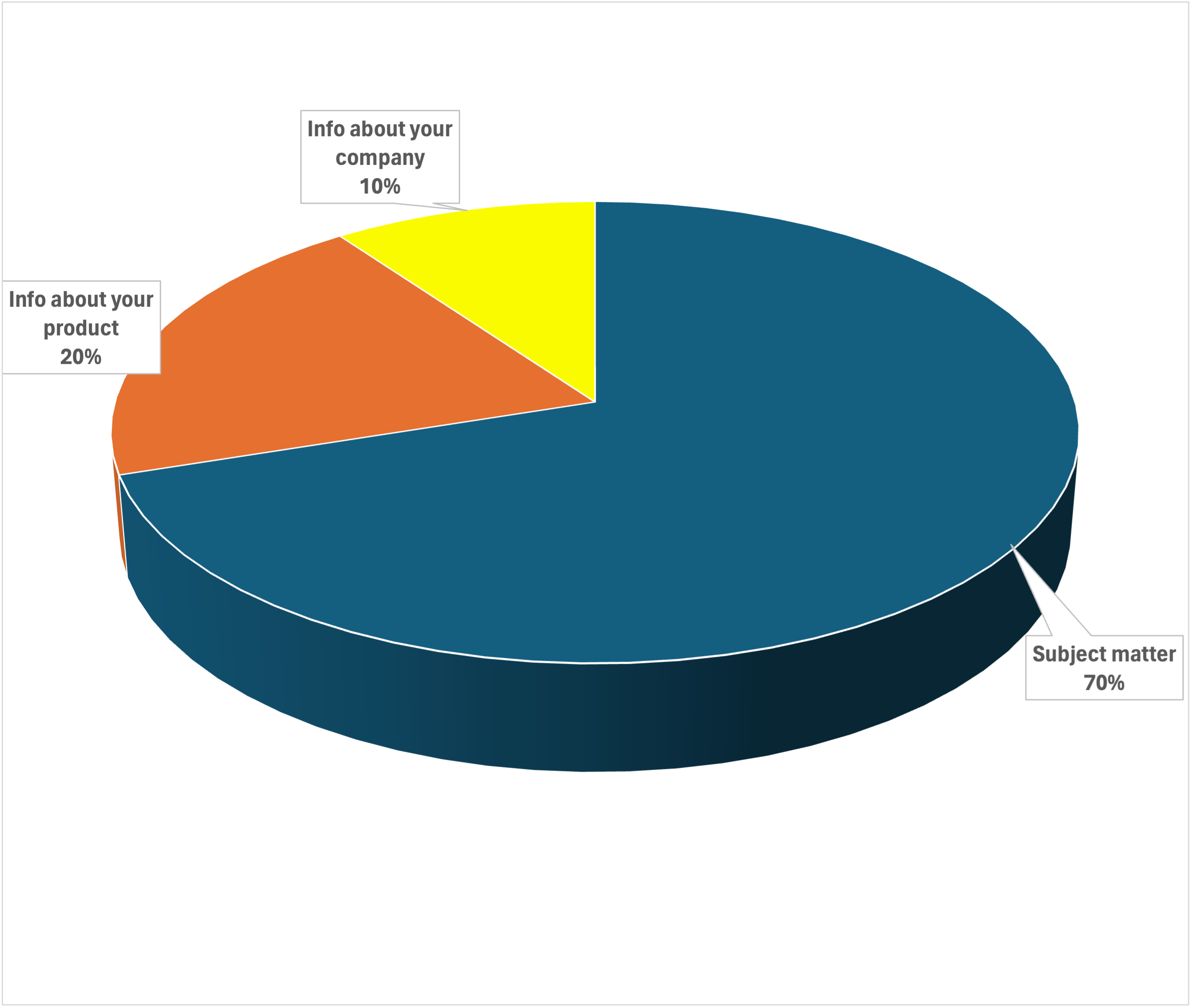
70% of the content discusses the topic of the paper, 20% promotes your product, and 10% introduces the company.
For instance, in a document with 2,000 words of text. 1400 should talk about the regulatory framework to onboard a PEP and then manage their assets. 400 words promote your product and 200 words introduce your company.
Content guides a prospect who does not know they need your product (let alone that your company exists), but has the problem your product solves and wants to find out more about the topic, rather than those who already think they need a product like yours.
It is a subtler and, possibly, slower way to attract prospects, but those who come to your company after reading your content are pre-qualified. They have (or, at worst, they are interested in) the problems your product is trying to solve. In a way, they are pre-qualified. They make the first step to get in touch,
You can have ideas for content by answering these questions
What are your product’s top-selling points (e.g., real-time PEP check)?
What is the problem you are trying to solve (e.g., a smooth onboarding process)?
What is a complex problem in the industry sector you are selling to? A problem your product can help solve (e.g. Only use 100% qualified data during verifications of the prospect identity).
Content includes advertising, but it is more subtle. Following the same PEP example above, the reader is frustrated by the complexity of identity verification during the onboarding phase of client acquisition. They read what to do to solve the problem. As they read about it, they found out your product exists. You can include a call for action or a next step. The basic one is to ask for their e-mail and their agreement to receive promotional material. You include how to contact you (or you ask for their e-mail before they download your content). If they decide to look at it, they will contact you for a demo.
It is the modern-day internet-based equivalent of a bird-catcher who stands in the middle of the square with bird feeds on the palm of his hand and waits for the birds to come to him.
It is a slow but more effective process. Advertising follows the scattergun approach, i.e. bombard as many people as you can with your message.
Content marketing sends the message out included at the end of a discussion of a relevant, slightly more generic topic and you wait to be contacted. It may sound passive rather than proactive, but it can co-exist with the scattergun approach of cold-contacting prospects.
Content marketing builds up your brand and raises the profile of your company. It establishes your expertise on a specific subject and is a more relaxed way to become known as a thought leader. The company to go to when that problem arises or when you have outgrown your current way of dealing with a specific topic. It is the first step towards becoming a household name.
I am a programme manager who turned into an expert in financial regulations. I worked all over the world, mostly in banking, and developed my storytelling skills, trying to find the story behind financial regulations. Now I tell stories about 1920s Venice, financial regulations, technology, and financial products, and help companies raise their profile.
Click the link below to organise a complimentary 30-minute Zoom meeting to discuss the stories behind your company and your products and how they can be turned into content.